
.png)
A teenage boy talks to his machine, giving it commands.
His first task begins innocently enough: “stand on one foot,” the boy says. The machine obeys.
His second task reveals a sinister edge: to target nearby onlookers. The boy orders his machine to grab one of them by the head, pulling him into the air while he screams. His friend tries to intervene, and the machine, leather-clad and 6 feet tall, draws a handgun, and just as it’s about to blast a hole in the man’s head, the boy screams “NO! Put the gun down now!” and stops him just in the nick of time.
This short scene from “Terminator 2: Judgment Day” captures in elegant shorthand the possibility and danger of using thinking machines. Released in the final months of the Cold War and nuclear annihilation remained a terrifying possibility, “Terminator 2” harnessed those fears and redirected them towards something more intimate: the rise of the computer, and unlike the atom bomb—which could only be misused by Governments—these machines would soon be in millions of homes around the world. The terrifying result? Using them would turn each person into a makeshift cyborg, with silicon computing becoming an amazing, but frightening, transhuman extension of how we think and behave.
At release, “Terminator 2” was a tech-noir cautionary tale on the rise of computers (in military application and at home). 35 years later, it plays as a cyberpunk mirror of how far we’ve already let technology disrupt and dominate our lives. From the devices we hold in our han to “smart” algorithms and predictive language models, we don’t have to carry laser rifles or battle armies of skeletal machines to feel as though we’re in a cyber-dystopia. Machines replace us in the work force, our dopamine is dependent on the addictive scrolling of our devices, and it’s never been easier to blur ethical lines in how you behave online. Whether through the moral prompts of how to use the T-800 or the propulsive set-pieces, “Terminator 2” demonstrates the more we use machines the more we risk becoming like them, and that the danger from A.I. isn’t necessarily a singularity superbeing starting World War III, but from the way we let technology change who we are in the first place.
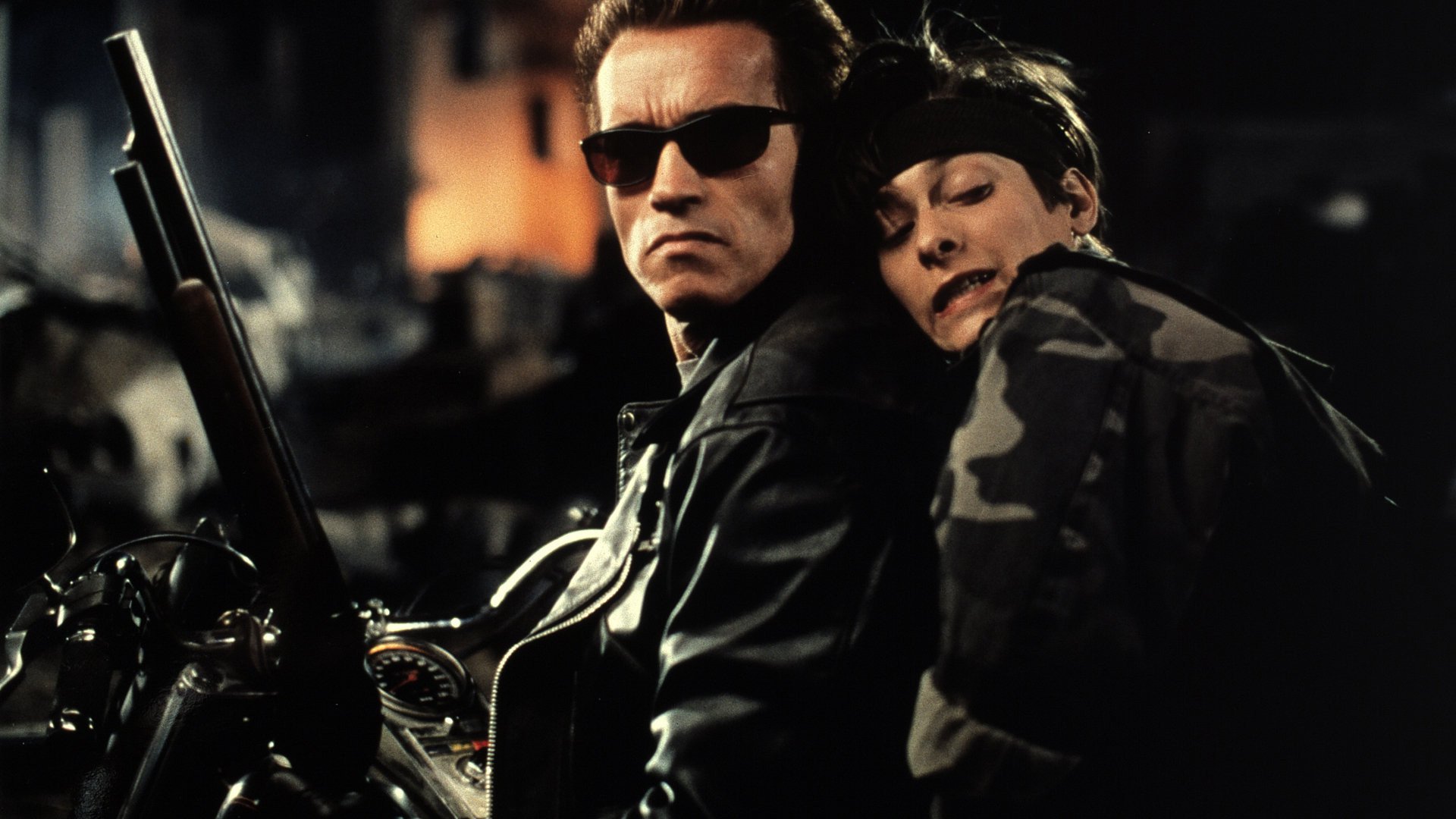
So when that boy, John Connor (Edward Furlong), escalates a physical gag into physical violence, he’s proven just how quickly machines blindside us into morally pernicious choices we may never have otherwise. Vigilance is required. It’s that key scene that sets John on the path to be the future leader of the human resistance, where in the far future (in the film, 2029) he fights against Skynet, a synthetic super-intelligence that enslaved humanity. To save his younger self, he sent a reformatted version of the villain in “The Terminator,” the T-800 (Arnold Schwarzenegger), which involves obeying any and all commands John Conner (of any age) will give. It’s for good reason: Skynet has sent the T-1000 (Robert Patrick) after John, a nexus point to save this once and future leader. The young John may have been told how this android operates—it will follow precise instructions without question—and yet his careless teenage words still nearly get a man killed.
Sometimes seen as a softer, less hardcore sequel to the straight-horror original, “Terminator 2” is still plenty horrifying; beyond the tests of will that Cameron imposes on the human characters, the film’s scares reveal the ways a digital intelligence can penetrate, and then distort, what we know reality to be. In what was a landmark leap in CGI technology, the body of the T-1000 is a kind of shape-shifting, liquid metal, and thus can take on any physical form, have any voice, or become any non-complex object: deepfakes that can kill you. It can trick a husband that his wife—already deceased off-screen—is still in the room. It can take on the blue dress of law enforcement, a not-so-subtle hint at Cameron’s dismal view of authority.
In one of the film’s most uncanny moments, the T-1000 breaks into a mental health facility by taking on the appearance of a security guard and terrifies the guard with, well, himself. Gazing at this digital homunculus leaves him terrified, only for the villain to morph his hand into a shimmering metal spike and kill him. It’s a warning by Cameron that soon, computer technology will be able to inhabit, if not also replace, human beings. Thus, the T-1000 is, itself, a meta-cinematic device. On its most basic level, the plot follows a killer computer repeatedly trying to kill a teenager, but on another, the clearly digital liquid-metal visual effects add an uncanny wrongness to the film’s moments, where something clearly synthetic, diegetically and to the movie audience, is attempting to replicate being human.
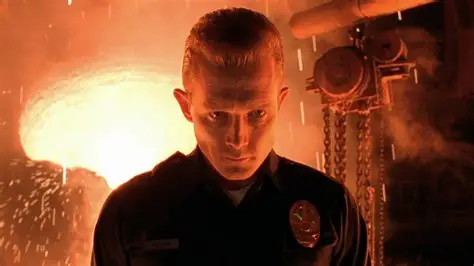
Part of Cameron’s genius with spectacle comes from his magician’s way to blend multiple techniques across micro-seconds of footage, like stop motion, reverse photography, CGI, practical explosions, and miniatures, to create a convincing tableau for his impossibly epic images. It’s just the same in “Terminator 2” and the T-1000, a mix of Robert Patrick’s lithe stunt work, makeup and prosthetics in the form of metallic geometry attached to Patrick’s body, and computer-generated imagery. It’s a combination that successfully makes him a frightening, wholly credible foe. It also, however, shows possibilities of the limits of machines: when the T-1000 liquifies and moves through a gate in the hospital, he forgets he’s carrying a gun, and is snagged on the bars. The weapon can’t move through like he can, and the T-1000 didn’t realize.
On one level, this is Cameron’s way of selling a cool visual effect. But on another, it’s revealing that something so seemingly advanced can still have its blind-spots. Even the way the T-1000 always re-absorbs its liquid metal is a disarming reminder that machines are closed-systems; they cannot iterate on themselves, and if they can adapt, they’re still slow learners. Each masterful set-piece becomes a chess match where the underdog heroes try to exploit a machine’s weaknesses (something that, if anything, is more cathartic today than at release). Sometimes that’s brute force—pumping round after round into its fluid metallic body—and, in others, it’s by forcing it into the extreme elements of ice and fire.
In fact, in some ways Cameron’s obsessive desire for photorealistic visual effects has led us to where we are today. From the enchanted tentacle of animated sea water in “The Abyss” to the effervescent beauty of the Na’vi in “Avatar,” the creation of a digital character as perceptually real as any human has been his life’s pursuit. Pause any close-up from “The Way of Water” and marvel at its artistry: the cracks of Ikran-feet around the hero’s aging eyes, the perfect pores that dot Neytiri’s’ face, the fidelity of skin as it wrinkles from an outburst of a teenager’s volatile emotion. The greatest triumph of his “Avatar” Trilogy is how while watching, you are seduced by its mimetic spectacle; you soon forget that none of it is really happening.
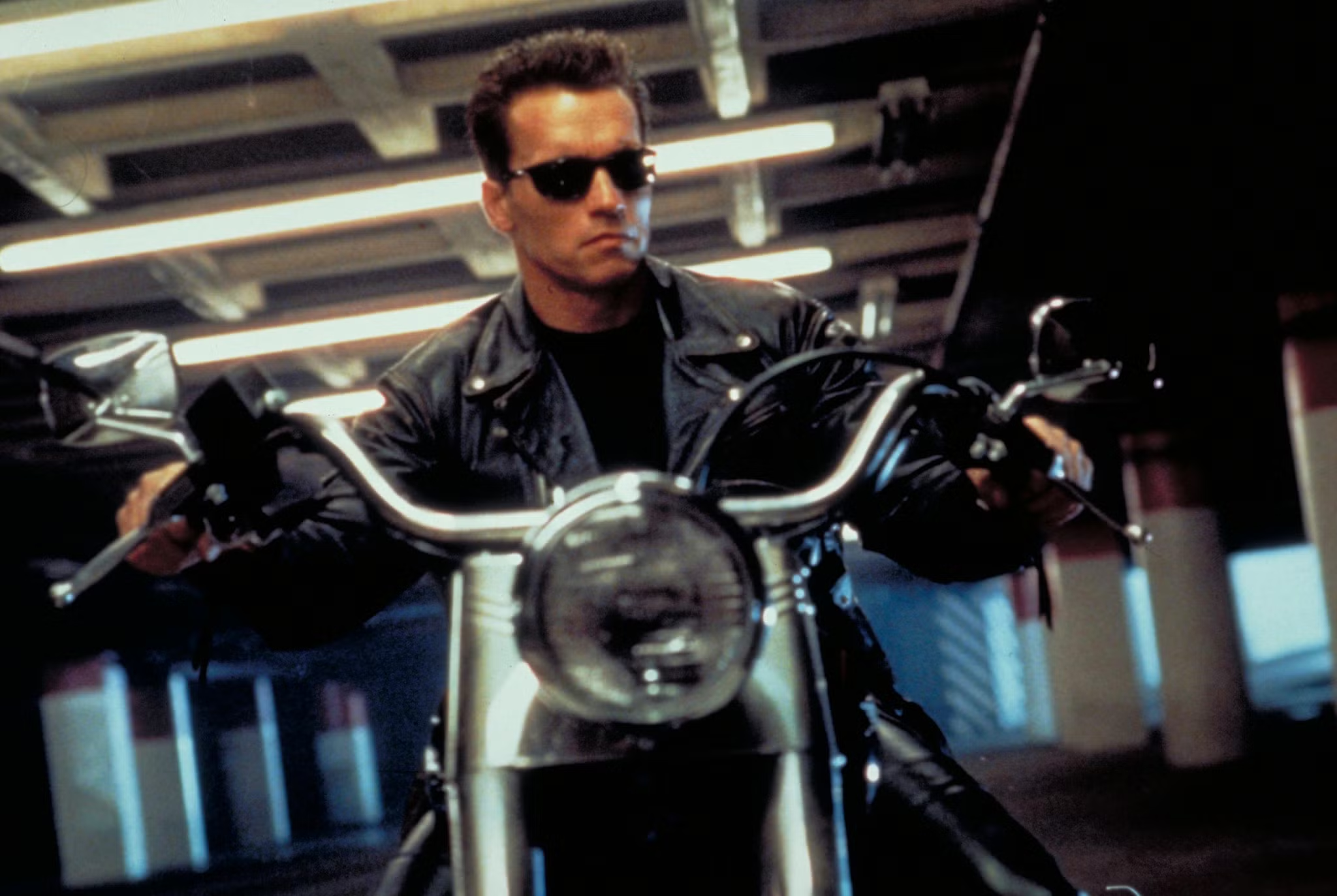
“Avatar” is the crowning achievement of how persuasively computers could create a fully believable, lush, dynamic and hyper-immersive digital world. Or, at least it was, until that same push for verisimilitude has (in a sense) encouraged A.I. programs like Grok, Sora and Midjourney to achieve the same, but with more unsettling results. Just as the T-1000 was a shape-shifting metaphor for digital tech in the ’90s since we can perceive a certain offness as it tries to inhabit different shapes and people, these programs have largely produced images that are lifelike but with details that betray its veneer of fidelity. For a long time, the most upsetting were by studying the hands: while the location, props, and even faces might look alright (if somehow, undefinably weird) images of people made by these applications might have too many fingers or too few. In some cases, the hands would appear as if they melted together under intense heat (ironically, one of weaknesses of the T-1000). Today, A.I. images come eerily close to replicating whatever they want, and just as John initially used his terminator as a bad actor to razz some nearby onlookers, the potential consequences for easy, thoughtless misuse are massive.
Far more insidious than any terminator attacker is how machines create gateways for our behavior to change for the worst, and it becomes extremely easy to embrace the digital devils of our worst selves. It’s why John’s interactions with the T-800 are so revealingly dangerous. It exposes the (now cliche) difficulty of how carefully we must choose our words when communicating with literal minded machines; a technical design comes with technically specific instructions. A.I. can only know what we program it to know, and even the most advanced language models in the world expose huge gaps in problem solving. This dilemma has given rise to a whole subset of sci-fi storytelling—from “I, Robot” (2004) and beyond, there’s the infamous sci-fi scenario of telling an A.I. super-intelligence to “protect humans” only for it to then enslave the human race since we are the greatest threat to ourselves. This is at the heart of landmark sci-fi writer Isaac Asimov’s law of robotics, where the first states “a robot may not harm a human, or through inaction allow a human to come to harm.” His stories would create complicated scenarios where artificial intelligence could do just that.
Likewise, John quickly realizes he still hasn’t solved the dilemma of how to work with the T-800. In one of Cameron’s most intense sequences, designed with low-angled shots that make the characters look a thousand feet tall, they have to spring his mom, Sarah Connor (Linda Hamilton), the main character of “The Terminator,” out of a mental institution. Though John has already given the command never to kill, the T-800 pulls his handgun and casually double-taps a security guard in both of his legs; John screams “what are you doing,” and the T-800 replies with Schwarzenegger’s effortless comic timing: “he’ll live.” John’s input removed one sort of action from the table, without accounting for others. The rest of the movie shows the T-800 balancing his non-kill rule with Cameronian blockbuster badassery, none more so than pumping rounds of gas into an army of police who have the building surrounding. They’ll live, but only just.
Worse, it reveals the critical issue isn’t whether John can control the T-800, but whether John can control himself. When John had the T-800 razz the two men nearby, they only approached after “his” android seized John and the boy screamed for help; they weren’t just random bystanders, they were good samaritans. Drunk off the power fantasy that this all-powerful action figure clad in biker leather will do whatever he wants, his line of empathy temporarily clicks off, and he abuses these men for no reason other than a cruel pleasure.
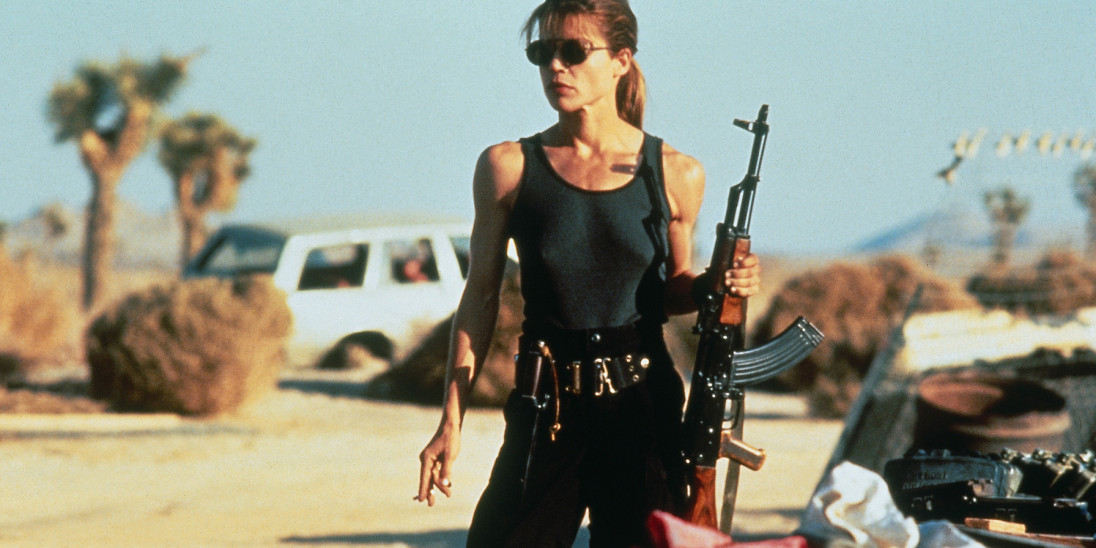
No one reveals that entangled psychology more than Sarah, who begins the film with enough hatred towards robotics that she gets thrown in a mental ward for trying to blow up machine factories. She gave up her motherhood for the cause. By the time the reprogrammed T-800 shows up to liberate her, she still holds a repulsive, virulent anger towards all machines. Expectedly, she panics when it first appears. But after they’ve escaped and she has time to stage her next steps, Sarah makes the decision, in Cameron’s words, to become a terminator herself and assassinate the man about to create the chip that will eventually launch Skynet, Mike Dyson.
What gets overlooked aren’t the ethics of her is-it-ethical-to-kill-baby-hitler sniper mission, but what comes immediately before it: in narration, she gives an uncharacteristically sentimental speech on why the T-800 is an ideal father for John. This machine isn’t only a valid or valuable ally, but a fit father figure, one that’s better than her past boyfriends and better, she imagines, than most fathers period. What she says is simultaneously true and untrue, a harsh if fair judgement of humanity. By this point, the T-800 hasn’t just learned to crack jokes or evolve with his “thinking chip” (in the “Special Edition” they remove a chip Skynet built to inhibit learning as a means of explaining his personality shift), he’s protected John better than Sarah ever has.
But Cameron, typically sharper a writer than he’s given credit for, has a dual meaning beneath what could sound like a mom’s cornball parental philosophizing: this speech is Sarah’s rationalization that the murder she’s about to commit is okay, that John will have someone to take care of him, that this new robotic dad, this machine, this computer moments ago she thought she could never bring herself to stop hating, will take care of him.
In other words, Sarah has made herself into a terminator by projecting shades of humanity onto a terminator, a more psychological version of the dilemma of John back in that parking lot. It’s not the orders she’s giving the machine that matters, it’s that the machine has allowed her to change, that it has allowed her to act on her worst impulses. In those moments, neither she nor John understand how the very existence of these super-machines can reprogram their behavior in ways beyond their self-conscious understanding. Once these machines exist, it is we who need to police what the machines let us convince ourselves to do, rather than a need to police the machines.
In one of Cameron’s greatest bars, the iconic “The future is not set. There is no fate but what we make for ourselves” speaks to today as much as it did when he wrote it. It’s a line that speaks against a predetermined universe, that no amount of certainty towards a worse tomorrow justifies a lack of action today. It’s a crucial bit of dialogue that recalls one of the ending lines from “Tenet”: “What’s happened happened. It’s an expression of faith in the mechanics of the world, but it’s not an excuse to do nothing.” So it is the same in “Terminator 2,” where there’s a time-loop that should make their situation fruitless. The chip Dyson is about to make is based on technology he only had access to because of the events of “The Terminator,” but that doesn’t mean we should not act to change it.
In 1991, computers were about to enter our homes before we realized all that meant. As if to complete the metaphor, Cameron set both “Terminator” climaxes in the iconic backdrops of an automatized machine factory, making his breathless action a forewarning that if we aren’t careful, we’ll soon be just as mechanized ourselves. Today, Cameron warns the next cycle of escalation won’t be in stock loads of nuclear weapons, but artificial intelligence, where wars will be fought between data centers instead of battlefields. At home, jobs will be lost. The CEOs of companies building these products insist these changes are inevitable, that there’s no use fighting the tide. The most powerful legacy of “Terminator 2” is to fight the fatalism of tomorrow, and to remember its refrain, “no fate.” Our digital age may have dehumanized and changed us, but we are still in control—and the future is always in our hands.
“Terminator 2: Judgment Day” will be re-released in a new 4K edition this Friday, August 28.
from Roger Ebert https://ift.tt/skzLxoU
.png)


