
.png)
When Michael Mann‘s “Manhunter,” an adaptation of Thomas Harris’ Red Dragon, was released in August 1986, it was not a success by any means—it received largely mediocre reviews that dismissed it as a case of style over substance and those reviews, combined with a title that meant little to potential viewers, a cast of largely unfamiliar faces and a new distribution company that was already floundering, helped to keep audiences away. However, once “The Silence of the Lambs” became a phenomenon in the early ’90s, and word got out that there was a previous film featuring Lecter, viewers found it. As the years went on, it would grow to be a cult favorite and reappraised by many as a masterwork in its own right.
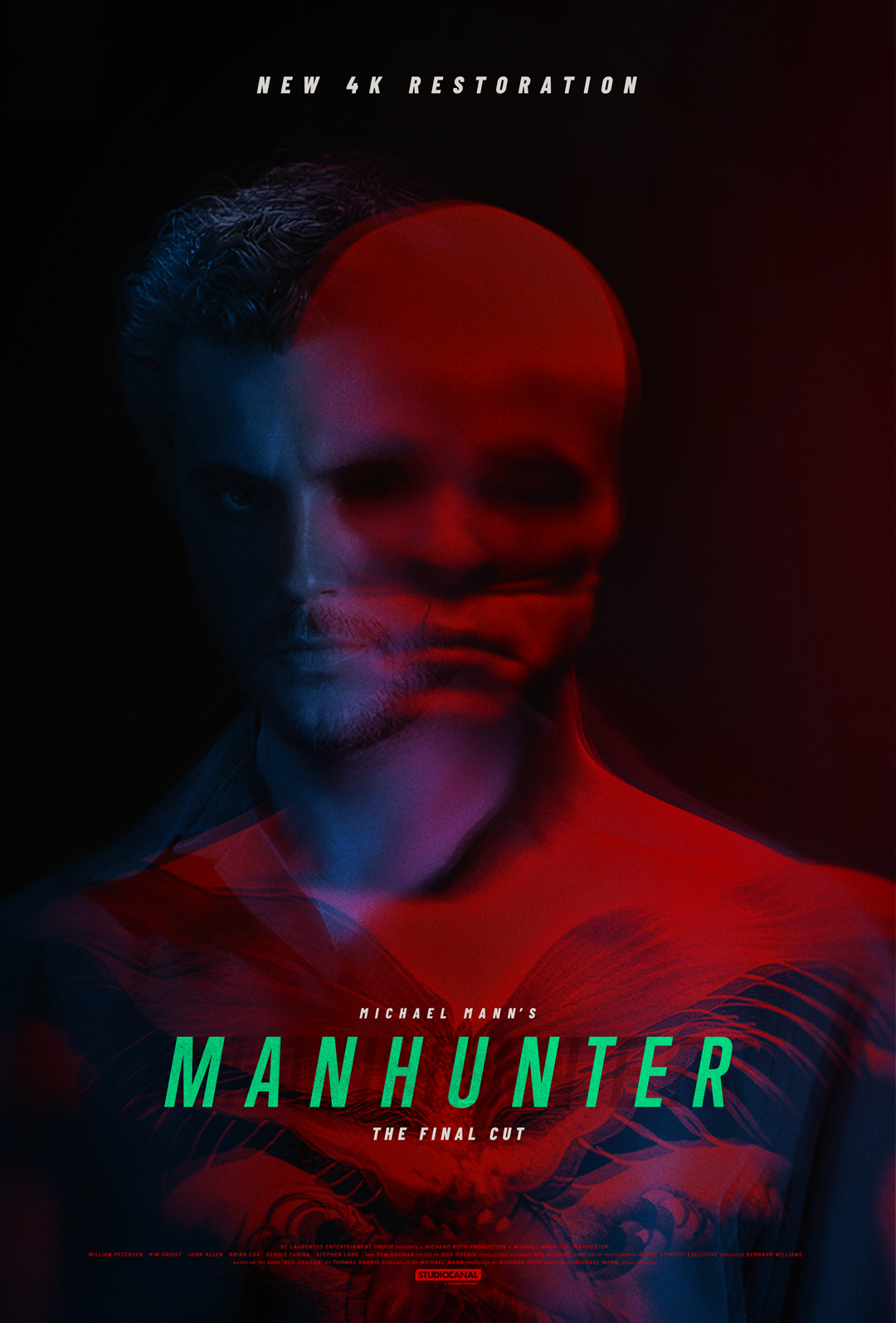
Now, 40 years after that initial theatrical stumble, the film is returning to theaters as “Michael Mann’s Manhunter: The Final Cut,” which gives viewers both a 4K restoration supervised by Mann and a new cut, though the newness may vary depending on how many of the various versions of the film that have emerged over the years that you have seen. Regardless of the changes, to see “Manhunter” on the screen is still a truly overwhelming experience that, save for a couple of moments that betray its age and the era when it was made, is as beautiful, fascinating and frightening now as it was back in 1986.
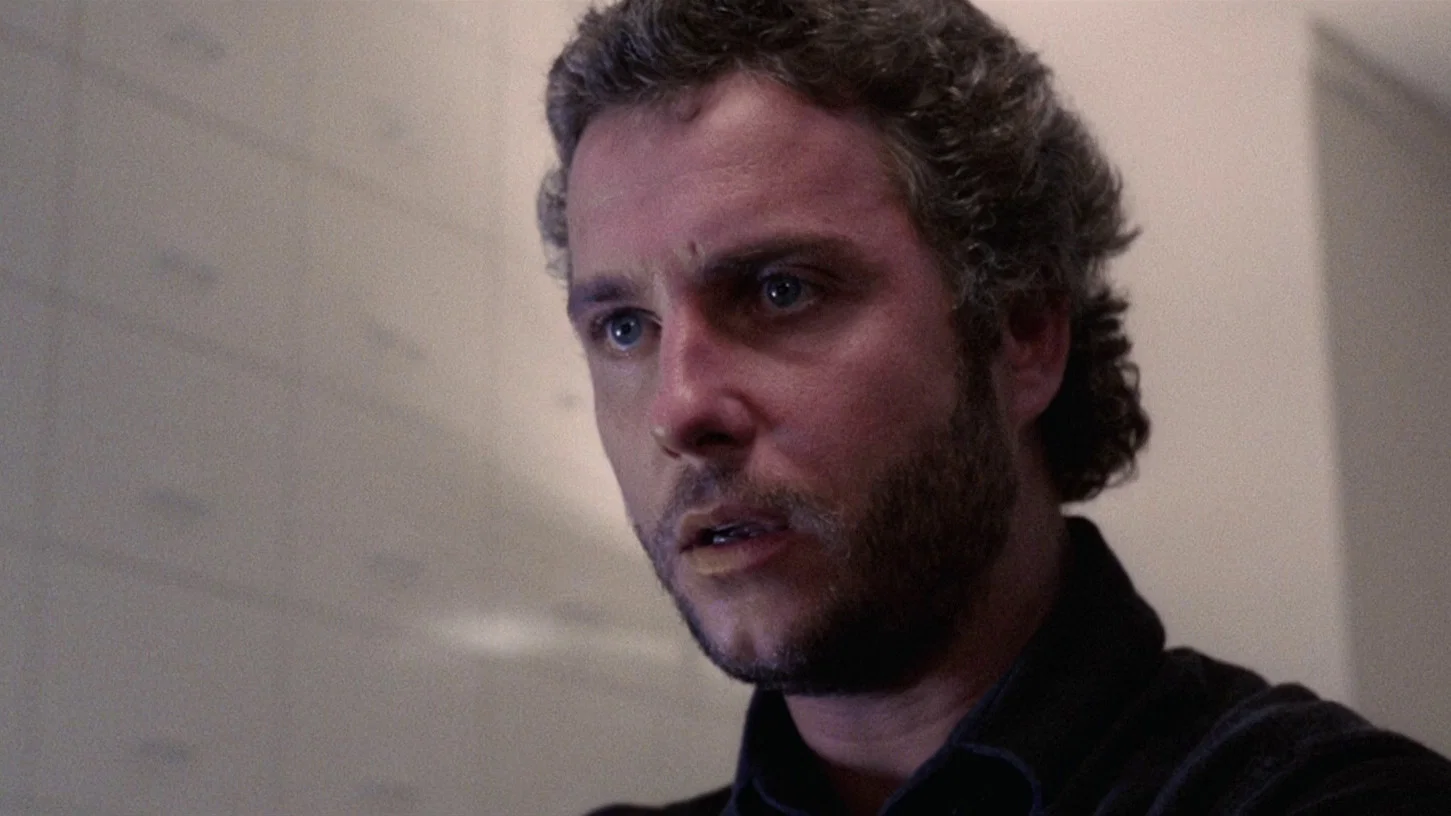
The film stars a then-unknown William Petersen as Will Graham, a one-time FBI criminal profiler with the ability to get into the mindset of the monsters that he is pursuing. The problem with this is that, once he does get into those mindsets, it isn’t so easy for him to return to normalcy. An attack by a serial killer named Dr. Hannibal Lecktor (Brian Cox)—yes, the spelling is different—inspired a mental breakdown in Graham that proved much harder to overcome than the physical scars he received from the encounter. Now, he has retired to a seemingly bucolic life on the shores of Captiva, Florida with his wife, Molly (Kim Griest), and their young son Kevin (David Seaman) that, as the film begins, is interrupted by the arrival of Graham’s former superior at the FBI, Jack Crawford (Dennis Farina). He needs Graham’s skills to help them apprehend a new serial killer, an entity dubbed the Tooth Fairy, who has already butchered two entire families and seems poised to kill more unless he is stopped.
Graham isn’t exactly eager to return to the fold—he isn’t even sure if he can continue to make the connections with his unknown prey in the first place—and assures Molly that all he will be doing is examining evidence and won’t be anywhere near the action. When a hunch pays off in the revelation of a previously overlooked fingerprint, Graham finds himself pulled in further, even agreeing to meet with Lecktor (Brian Cox), ostensibly to get his professional insight but really to help him further get into the killer mindset, a gambit that Lecktor almost immediately recognizes which inspires him to have a little bit of fun at Graham’s expense, though few will quite agree with his particularly brand of funning.
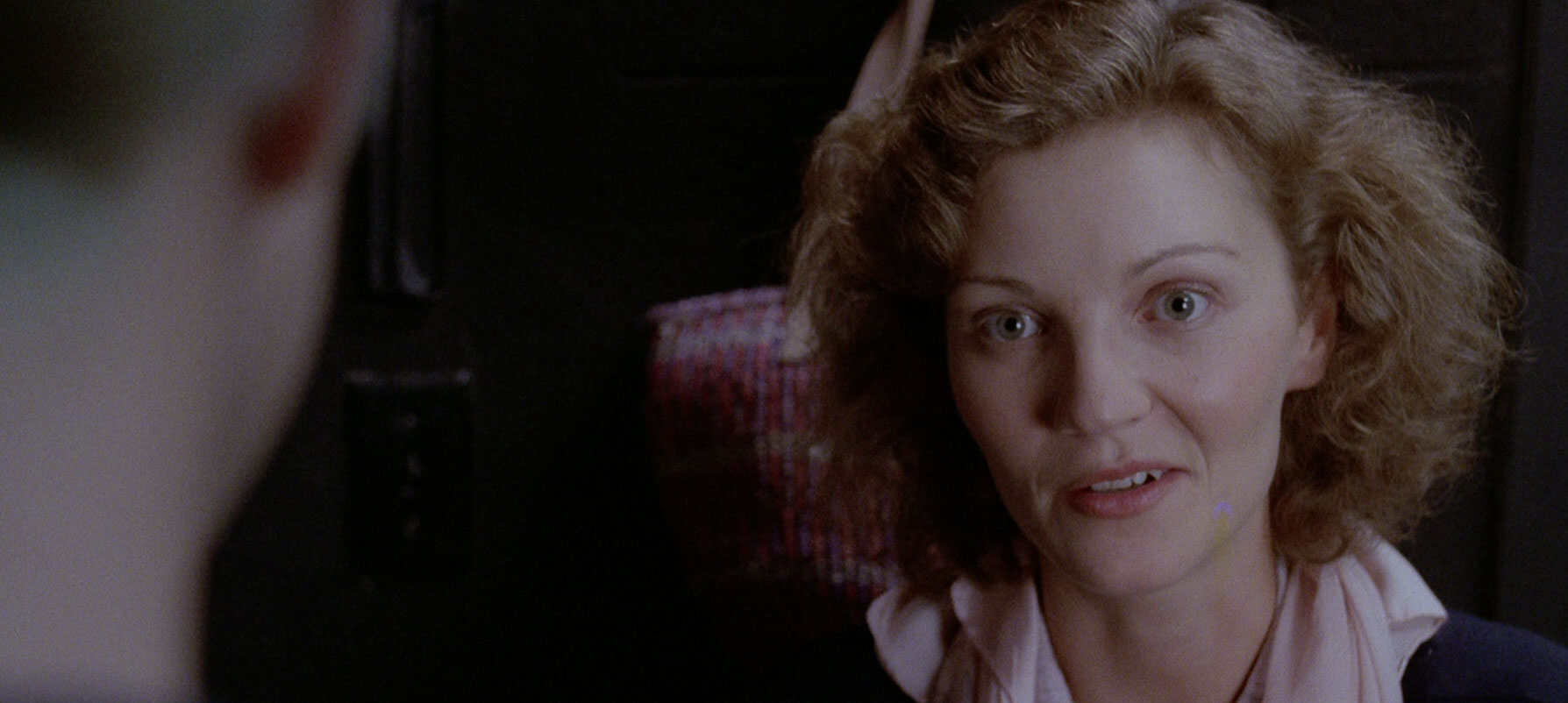
While Graham is pursuing his target in the hopes of finding them before the end of the lunar cycle that they seem to be working off of, the film moves to a second narrative track to introduce us to the Tooth Fairy himself, a St. Louis film lab worker named Francis Dollarhyde (Tom Noonan), a man with the kind of large, intimidating presence that, if he got in line behind you at your local coffee shop, you would not only leave but reconsider your devotion to caffeine. One day, he meets co-worker Reba McClane (Joan Allen), who doesn’t shy away from him—the fact that she is blind surely being a contributing factor—and they spend an evening together that veers from strange to creepy to romantic and leaves him with the sense of acceptance for which he has been searching. Inevitably, it doesn’t last as a misinterpretation of events essentially destroys what humanity remains in him and sets the final act into terrifying motion.
You have to remember that at the time that Red Dragon was published, serial killers were not as prevalent in popular culture as they would eventually become; material of this sort was considered to be bleak beyond compare. In fact, one director that infamous producer Dino De Laurentis had contacted about doing the film version rejected it after reportedly finding the material “violent and completely degenerate.” (That filmmaker was none other than David Lynch.)
The project landed with Michael Mann at an odd point in his career. The former TV writer had made two feature films and while the first, the heist drama “Thief” (1981) earned decent reviews and did okay at the box office, his 1983 adaptation of F. Paul Wilson’s WWII-era supernatural thriller “The Keep” was a project beset by post-production issues and fights with the studio that ended up being a critical and commercial disaster (albeit a stylishly made one that is still worth checking out).
However, this misstep was all but forgotten a year later when a new cop series on which he served as an executive producer, a little thing called “Miami Vice,” would instantly become one of the most groundbreaking and influential shows of its era. As it happened, the “Miami Vice” connection would be at least a part of why this film was initially dismissed by critics. Although the narrative more or less followed the basic parameters of Harris’ novel—though he would drop such elements as the detailed look into Dollarhyde’s background and the book’s original climax (which Dario Argento would more or less pilfer for the ending of his 1987 giallo “Opera”)—he and cinematographer Dante Spinotti would use a number of stylistic gambits to help place viewers into the mindset of the characters as a way of putting them in Graham’s shoes, ranging from strong color tints (a cool blue for Graham to represent the peace he has found since leaving the FBI and a grisly green to suggest the chaos within Dollarhyde) to utilizing a different frame rate at one key point to underscore the chaos. Unfortunately, few at the time recognized what Mann was doing here and instead condemned it as coming across as nothing more than an extended “Miami Vice” episode that was all style and no substance, which did little to spark interest in an audience that was already beginning to move away from that show.
It boggles the mind that so much of what Mann does well here was more or less summarily dismissed. Right from the start, Mann locks into a unique mode of suspense and dread, and manages to maintain it for the whole of his running time, one that does not necessarily rely on big action beats to keep things going. In fact, one of the most gripping and engrossing sequences in the entire thing has Graham and Crawford walking a potential piece of evidence found in Lecktor’s cell through a group of FBI analysts (including one played by, of all people, Chris Elliott) in order to glean anything they can before they have to return it—the kind of process sequence that would ordinarily get the short shrift in most procedurals but which turns into a genuine showpiece here. An equally strong moment, and one equally bereft of traditional thrills, comes near the end in an anonymous hotel room where Graham and Crawford alternately despair and turn on each other over their lack of progress; Graham’s burst of white-hot anger ends up being the impetus for the revelation that finally breaks things open (a revelation that admittedly may not have much impact for modern audiences seeing it for the first time but was indeed a blood-chiller back in the day).
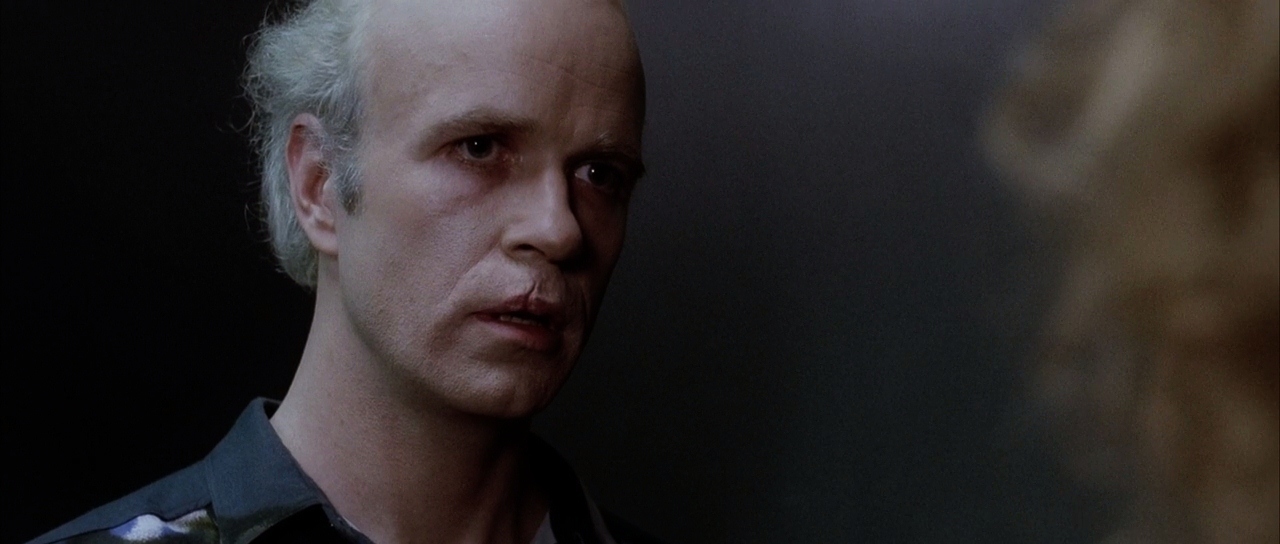
There are plenty of more traditionally unnerving moments as well, ones that remain discomfiting to watch no matter how many times you have already seen it. There is the encounter between Dollarhyde and Freddy Lounds (Stephen Lang), the obnoxious tabloid reporter who Graham has utilized in an attempt to flush out his target, a sequence that starts off on a tone of dreadful terror, builds from that without any overt violence and climaxes with one of the most jarring shock moments you will ever see. At another point, Graham is on an airplane sifting through one of the case files before going into a reverie about Molly that he is suddenly jarred out of when the little girl sitting next to him notices the gory crime photos on his tray. Then there is the climax, where the combination of the deliberately jarring color scheme, the equally wild production design from Mel Bourne and a particularly inspired musical choice leads to a sequence that plays like a master class in the art of suspense cinema.
Adding greatly to the power of the film are the performances delivered by a cast of actors who were not particularly well-known but prove to be ideally cast. Before this film, William Petersen was a Chicago stage actor whose only previous film appearances were a bit part in Mann’s “Thief” and the lead in William Friedkin’s 1985 crime thriller “To Live and Die in L.A.” His work here is particularly strong, both for the way that he is able to suggest the internal struggle that he faces with the dark psyche that allows him to do his job so well but at the risk of his own sanity and for the way that he is able to verbalize Graham’s internal monologues while grasping for clues without making it sound contrived. (Petersen would, of course, going on to star on “C.S.I.,” a show that is so obviously inspired by this film that it could easily be mistaken for a legitimate adaptation.) As his target, Tom Noonan (who passed away earlier this year) is just as strong, primarily because he doesn’t play Dollarhyde as some kind of slavering maniac. He is a monster but in his encounters with Reba, we get hints of the gentler soul that still exists inside of him to some degree—when the misunderstanding that finally pushes him over the edge occurs (“Francis is gone. Francis is gone forever.”), the moment is not just scary but strangely heartbreaking as well.
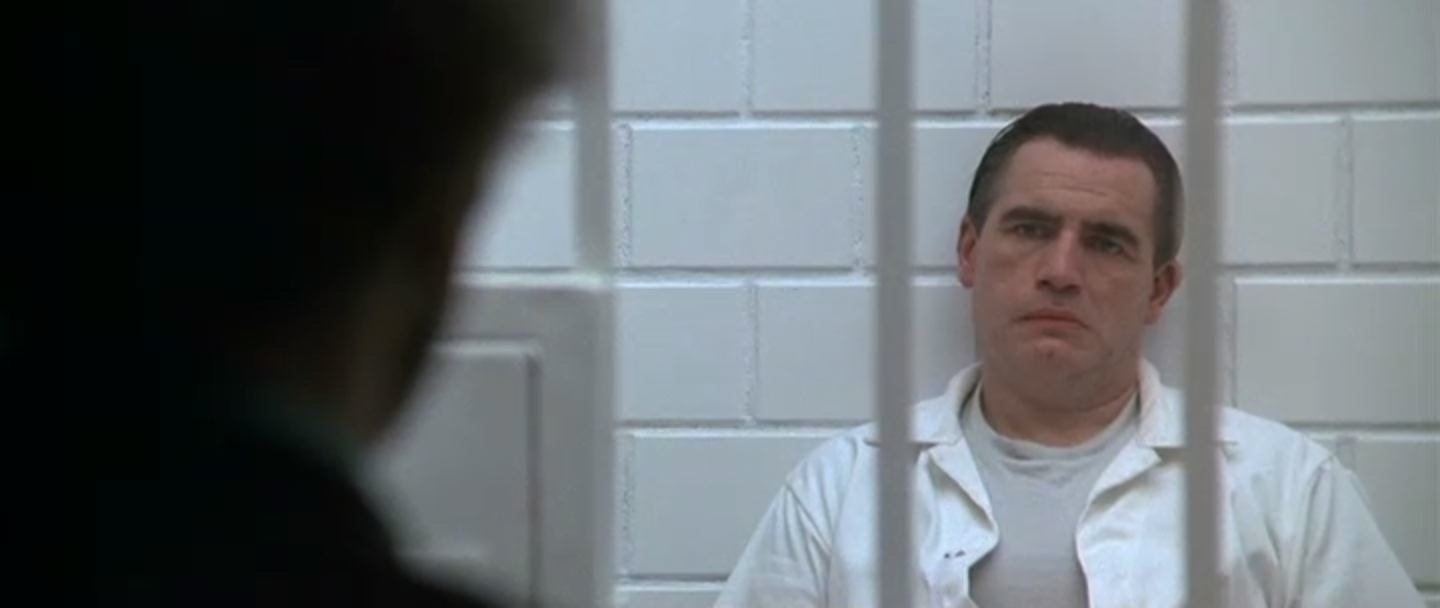
Although Lecktor is only a supporting character in the story, Brian Cox dominates every scene he appears in with a turn that is more subtle than Hopkins’ cheerfully scenery-chewing turn in the role—even while engaging in his lightly ironic banter with Graham, you always get a sense of the immense damage that his Lecktor could unleash. All of the supporting players are equally strong but special note goes out to Joan Allen, another Chicago stage performer whose only previous film work up to this point was a role in “Compromising Positions”—given the kind of role that should be almost unplayable (the blind woman who briefly brings humanity to the monster without knowing who he really is), she manages to make her into such a believable and compelling character that it takes viewers unfamiliar with the story a couple of minutes to realize that she is supposed to be blind.
In many ways, “Manhunter” is a product of its era—the visual style and the clothing choices pretty much scream ’80s throughout—but the film as a whole has aged so well that it is easy to accept the occasional excesses. The only aspect that feels dated these days is the music, an area that Mann has always made prominent in his works, from the scores composed by Tangerine Dream for “Thief” and “The Keep” to the contemporary pop hits backing the action every week on “Miami Vice.” In this film, he tries for a hybrid of the two approaches that doesn’t quite land. The score by the Philadelphia band The Reds and composer Michel Rubini is perfectly fine, if perhaps a bit too overwhelming at a couple of points where less might have been more. However, there are a few songs dropped in here and there that prove to be a distraction (particularly during the love scene between Francis and Reba). The film makes up for these excesses by providing one of the all-time great needle drops by scoring the extended climax to Iron Butterfly’s “In-A-Gadda-Da-Vida,” a merging of sound and vision that fits together so perfectly in bringing Graham and Dollarhyde together at last while signifying their shared mental disintegrations that you would swear that it was written specifically for the film.
Over the years, as he has done with a number of his films, Mann would fiddle with “Manhunter,” resulting in a number of different versions leading up to what he promises is its final iteration. This Final Cut is pretty much a cleaned-up version of the Director’s Cut that he prepared for home video back in 2003. It drops a couple of moments, slightly extends a couple of scenes and adds a scene towards the end where, after the final takedown, an emotionally battered Graham visits the home of the family who were going to be Dollarhyde’s next victims in an attempt to help recalibrate his mindset before going back home to his loved ones. In terms of recuts, Mann is kind of hit-and-miss as a whole—while his rejiggering of “Blackhat” was an improvement, his tweaks to things like “The Last of the Mohicans” and “Miami Vice” were much less effective. Here, the film remains fundamentally the same; the changes don’t really bring anything new to the party other than the remastered visuals and sound. Personally, I still prefer the original theatrical release—it is the one that I first saw back in the day and which struck me so strongly—and when this new variation eventually arrives on home video, I hope that this initial version is included as well.
Whether it is that original version or this new Final Cut, “Manhunter” is a flat-out masterpiece that is both Mann’s greatest work as a filmmaker as well as one of the greatest cinematic thrillers ever made. Balancing an alternately gorgeous and haunting visual style and gripping and twisty/twisted narrative with compelling characters and convincing emotional stakes, it is a film that grabs you right from its creepy opening moments and holds you spellbound until the end credits roll, and most likely long after that. For those who have never seen it before, Mann’s striking combination of art and pulp will stand out in stark contrast to the comparative mediocrities of contemporary thrillers. For those who have seen and adored it, you will be relieved to know that it is still as tense and watchable as ever.
“Michael Mann’s Manhunter: The Final Cut” is playing in limited theatrical release starting July 24, and traveling throughout August.
from Roger Ebert https://ift.tt/Fap3DRW
.png)


