
.png)
Midnight movies are hard to watch at Sundance, mostly because once you mix altitude with sleep deprivation, it’s difficult to keep focus on even the goriest of visions. Nevertheless, the three films in this dispatch are so uniquely wild in their premises and varied execution that it was difficult not to have my eyes locked on the screen, especially when it comes to the first film up, whose interlocking of horror and place is quite unique.
In a small Australian town, two queer kids—Naim (Joe Bird) and Ryan (Stacy Clausen)—share furtive glances and intense kisses in an abandoned mill. Oftentimes, violence, like the rough play fighting they often engage in, incites their sexual passions, which they must conceal in their fiercely religious town. Their adolescent passion turns deadly, however, when Naim discovers Ryan cheating on him with the preacher’s son; so naturally the jilted teenager spitefully reports his lover’s tryst. The solution by the preacher is to call a deliverance healer to “pray the gay away.” This healer’s spell, in actuality, is a curse—causing the bearer to see visions that turn their desires murderously onto them.
The simple premise in “Leviticus,” a film by writer/director Adrian Chiarella, often recalls “It Follows.” There is seemingly no way to shake this malicious presence; though it appears to the afflicted, it’s never visible when others are around. The test for Naim and Ryan is to navigate their desires amid their equally hostile local environment. To visually demonstrate the kind of violent isolation that occurs for a queer kid in a rural community where they’re forced to remain closeted, Chiarella often leans on frames featuring heavy negative space, whose only occupant is a single person. In that way, the director crafts a firm world, earning the leeway required to believe that Naim and Ryan’s longing would be strong enough to continually put themselves in harm’s way.
That suspension of disbelief is absolutely necessary, especially because oftentimes this malicious presence is quite frankly one-note. It’s so clearly sinister and rarely charming, to the point that you just have to chalk up the myriad dumb decisions that Naim and Ryan make to the overdrive of hormones that happens when the very act of love is the ultimate adrenaline rush. Similarly, Naim’s mother (Mia Wasikowska) is fairly predictable in her apathy, making one wish that Chiarella could locate another layer to their conception of “Brokeback Mountain” as a horror movie (this film makes several allusions to Ang Lee’s queer classic). Nevertheless, the filmmaker does land a perfect final note whose sense of devotion is divine and aching.
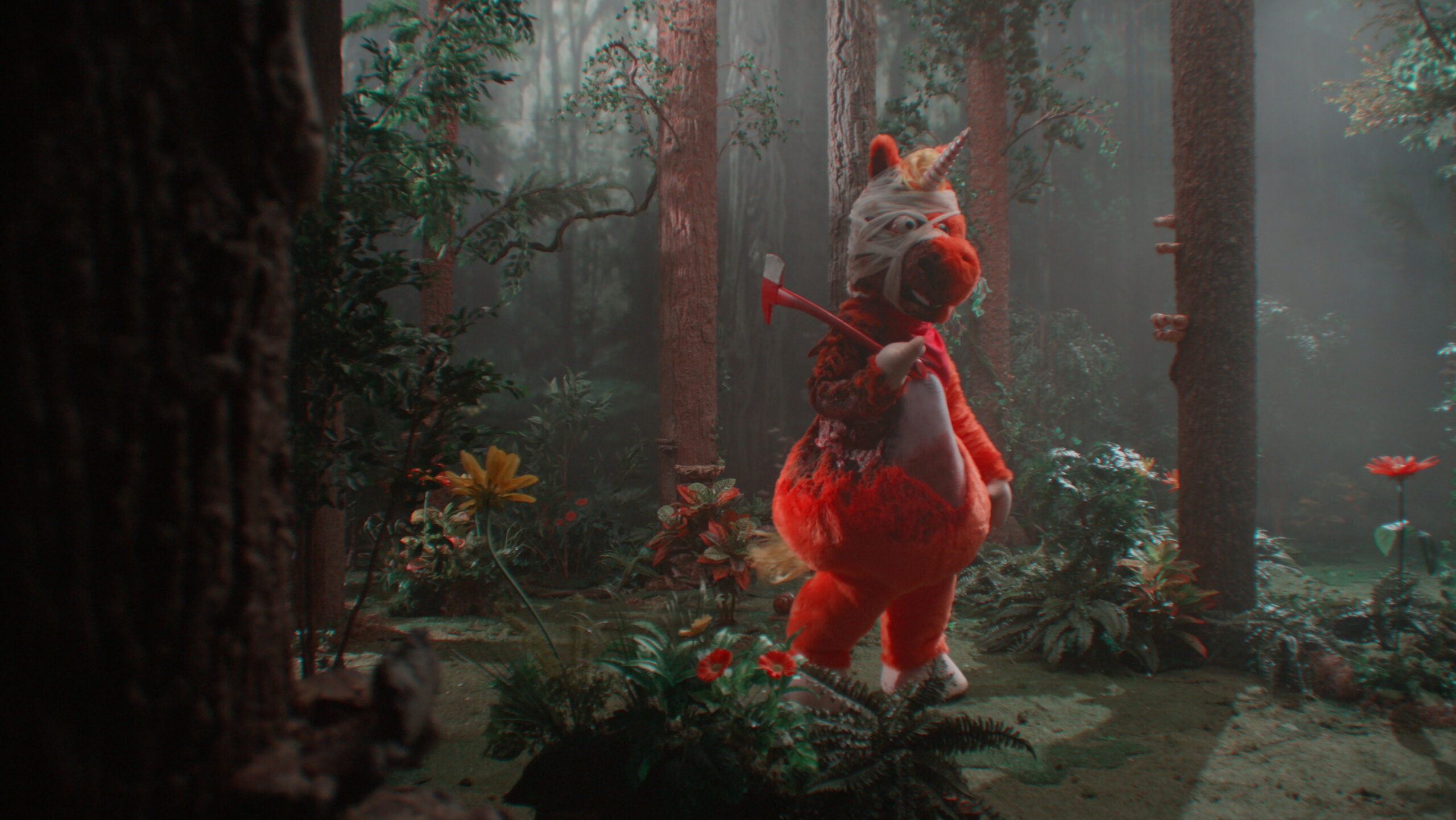
Bizarrely hilarious yet tonally uneven, Casper Kelly’s murderous satire “Buddy” takes place inside a late-1990s children’s television series called “It’s Buddy,” where, similar to “Barney & Friends,” four kids perform activities that are meant to teach them lessons about cleanliness, sharing, and caring. At first, it seems like everyone loves the joyous Buddy, an orange unicorn with a yellow mane voiced by Keegan-Michael Key. But when one child refuses to participate in a dance prior to Buddy’s party, the children’s benevolent leader turns sinister.
Kelly’s 95-minute dark satire often recalls his Adult Swim episode “Too Many Cooks,” which took aim at American family sitcoms for bleak comedic effect. In “Buddy,” he recreates child programming with equal detail. There are random side characters like a nurse, a mailman, and a giant pink bunny rabbit. There are also talking objects, like a mailbox, couch, wishing well and a train. The kids sing wonderfully cringe songs dedicated to the delightfulness of performing menial tasks. In the early going, we run through several episodes of the show, which reveals two frights. The kids, who should be child actors, seemingly never go home. Also, their glossy exteriors, particularly that of Freddy (Delaney Quinn), start to fade as they realize the danger Buddy poses. I won’t go any further than that because there are plenty of twists and turns, including a voice appearance by Michael Shannon.
What I will say is the film loses significant steam after its opening act. Kelly has so much fun in this imagined, affected world—crafting significant laughs from depicting imperiled children—that when he leaves to explore a separate plotline involving Cristin Milioti and Topher Grace as struggling parents, the tonal momentum dissipates. In the latter arc, Kelly reimagines his film as a serious paranormal mystery. It never quite works because the emotions shown by these parents rarely make sense. “Buddy,” nevertheless, does recapture some of its magic by the end—opting for references to “Night of the Hunter” and “The Matrix Reloaded.” That re-footing isn’t totally enough to absolve “Buddy” of its missteps, making it a delightfully bleak, mostly missed opportunity.
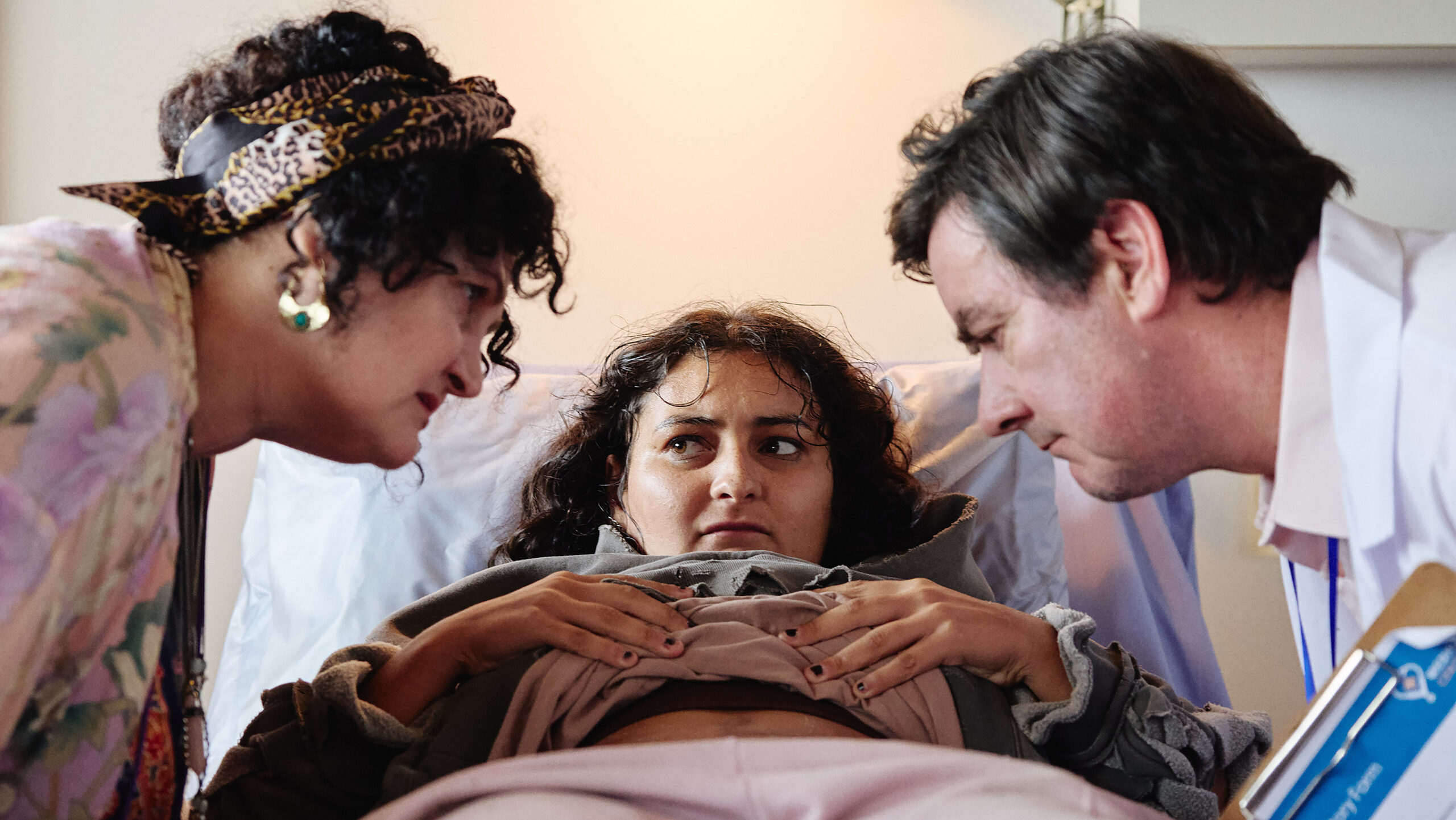
I am admittedly still not sure what to make of the freakish, extraterrestrial comedy “Mum, I’m Alien Pregnant.” Like all of the world’s other eccentricities, the film hails from New Zealand and is concerned with the plight of motherhood while it takes aim at kids experiencing a failure to launch.
Directed by THUNDERLIPS (Jordan Dodson and Sean Wallace), the film opens with intense flair. Mary, a loner, dips potato chips into some deliciously photographed ice cream while basking in the sun. She lives with her doting mother Cynthia (Yvette Parsons), who desperately wants her to get married and have a child. Mary instead finds sexual pleasure watching anime, particularly any featuring tentacles. That kink comes to uh a head, when Boo (Arlo Green) and his mother Ann (Jackie Van Beek) move to their neighborhood. Boo is the product of his mom’s alien abduction and therefore has an alien penis replete with, you guessed it, tentacles. Intrigued with one another, Mary and Boo mutually masturbate in a laundry, instigating Boo to shoot green acidic alien jizz across the room onto Mary’s pants. That intercourse impregnates Mary.
THUNDERLIPS aren’t afraid of grossing out their audience (points for showing Boo’s alien penis), pushing Mary and Boo through an exaggerating pregnancy that dials up the way women’s bodies change while expecting by more than a few notches. They’re also pro-choice, finely walking Mary’s desire for bodily autonomy with the comedy of her carrying her baby to term. The latter component may rub some viewers the wrong way, causing one to wonder why a woman unable to terminate pregnancy would be played for laughs even as the film tries to show all the systematic ways women are robbed of their choice. Moreover, the film also questions the passive role fathers play during pregnancy by wagging its finger at Boo’s hesitancy to support Mary and his baby.
How well this all lands is partly dependent on the dry humor espoused by the film’s committed cast, who are able to keep things lively even as the alien component borders on feeling like a gimmick; Boo’s mom, in particular, appears to be unwritten. How is it we never get details about her abduction and how that trauma has emotionally manifested in her? One could argue, I suppose, that it made her extremely protective of Boo. But then why don’t we get a greater emotional response from her when it becomes clear that Mary is going through a similar pregnancy journey?
Instead, “Mum, I’m Alien Pregnant” is a thin film that survives on energy and humor, of which it has plenty.
from Roger Ebert https://ift.tt/rnwEsaA
.png)


