
.png)
Though by no means a filmmaker with one interest, Rian Johnson has always had faith on his mind. The director of the films “Brick,” “The Brothers Bloom,” “Looper,” “Star Wars: The Last Jedi,” “Knives Out,” and “Glass Onion,” he’s long been interested in turning various genres inside out to get at deeper ideas about the people at their core. With “Wake Up Dead Man” (now playing in limited theaters, on Netflix December 12), the third and best film in the Knives Out series, he reflects on religion by taking on not just death but what it means to a person of faith in 2025.
The person in this case is Josh O’Connor’s Father Jud, a charming and compassionate young fellow wrestling with a painful past. When he’s sent to a new parish after punching out a rude deacon, he’ll find his faith tested as he begins to work underneath the tyrannical Monsignor Jefferson Wicks (Josh Brolin) who oversees a troubled flock of parishioners alongside his loyal second-in-command Martha Delacroix (Glenn Close). When death takes hold of the church and Jud is made into the primary suspect, he’ll need to work with the now famous Detective Benoit Blanc (Daniel Craig) to clear his name as well as set things right for all those he can.
While “Wake Up Dead Man” boasts a strong ensemble cast, Jud’s salvation, as well as the answers to the mystery, may come from those like Bridget Everett’s Louise who come into the film and complicate the experience in an unexpected, yet deeply moving, fashion. Increasingly, the film becomes about the moments where we take a step back from the sharply well-written murder mystery itself to look at the bigger picture of it all. There remain plenty of clever twists and hilarious jokes that Johnson crafts, though it’s also about excavating what the film calls a “road to Damascus” revelation or the reason you’re here in a world that’s falling into darkness.
In conversation, Johnson discussed “Wake Up Dead Man,” the scene that serves as its thesis, finding his own road to Damascus moments in the everyday, how Josh O’Connor is the modern Jimmy Stewart, his evolving relationship to his faith, and how cinema became his church.
This interview has been edited and condensed.
I’m speaking to you for RogerEbert.com, the site of the late, great Chicago critic. The city is home to many great critics, including the Pope.
Yep, you got him.
Did you see recently what the Pope had said? Because it came to mind when I was watching your film several times.
I did. I read his thing that he said to the group of assembled filmmakers and I thought it was so beautiful. I hope the Pope sees our movie, how cool would that be?
Have you sent him a screener?
I personally have not [laughs]. But I think we probably should, I’m going to start asking about that. I’m not sure what the pathway is to getting it to him. I’m sure they have a screening room in the Vatican. We got to figure it out.
I hope so. The part that came to mind from his speech was “defend slowness when it serves a purpose, silence when it speaks and difference when evocative.” I won’t give away the moment in the film, but there is a moment, the Damascus moment, the phone call, where everything slows down. I was curious when you arrived at that because it felt like a moment to breathe, to exhale.
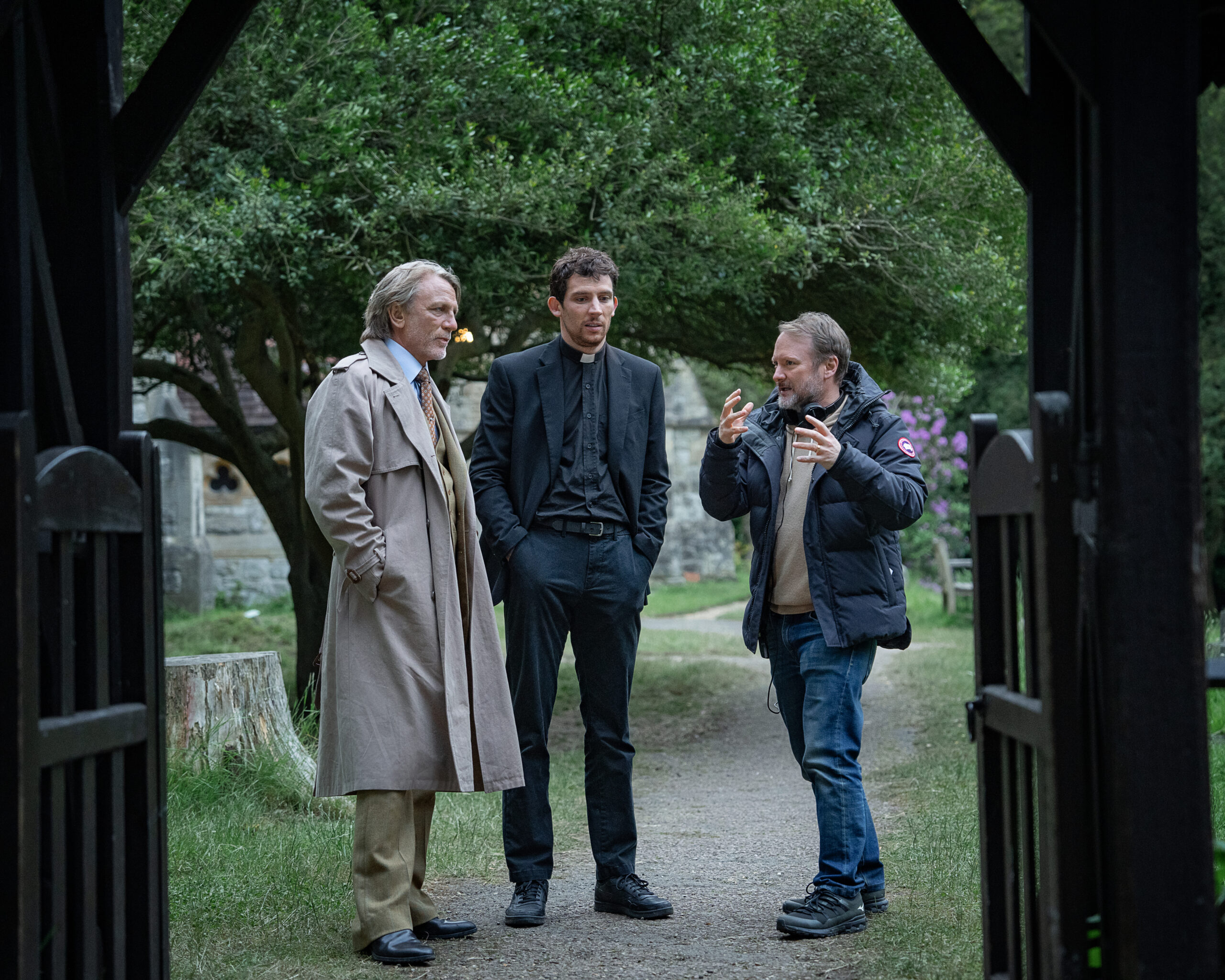
I appreciate that man. That moment is, for me, the heart of the movie. The way I write is I outline extensively. I do a lot of planning so that when I sit down to type I have a real plan to go off of. That was a moment that actually came very organically while I was typing. It was going to be something totally different that happened then and I just kind of followed my instinct and ended up writing this scene in this way. It’s a huge turning point for Jud and it’s also the thesis of the whole movie. Jud is a priest who genuinely wants to bring Christ’s love to people. He wants to be selfless, he wants to serve. He ends up in the middle of a murder mystery movie. He ends up being swept along with Benoit Blanc on this murder mystery mission of finding the bad guy, bringing them to justice, punishing the guilty, clearing his name and setting things right that way. Just like us as an audience, Jud gets very swept up in this. Then there is this moment where he is reminded that he is a priest and this game is antithetical to what he is set on this Earth to actually do. So it was a very central moment for the character. But then shooting it, having Josh O’Connor on the phone with the great Bridget Everett, who’s an amazing actor, what they did with that scene, I love watching that scene.
I would be remiss if I didn’t mention Bridget Everett because the “Somebody Somewhere” brigade, I imagine, are going to love that moment, where it feels like it could be a throwaway scene but then unlocks the whole movie. When did you first become familiar with her work?
I was familiar with her show [“Somebody Somewhere”]. I think her show is absolutely brilliant. I think she’s extraordinary in it. I knew her work as a singer and as a comedian, but it was really her show that stabbed me in the heart. It’s a tricky part to play. It’s always tricky when you’re playing a part where you drop in for one scene and have something important to do. It’s also a role that starts out, you think it’s just a comic foil, you think it’s kind of a joke, and then it has to turn into something else. But having seen what she does and how honest she is in every moment of doing it, I knew she could pull it off.
Was that a Damascus moment for you? What has been a moment in your own work, or other’s work, that you feel has unlocked what you were meant to do?
I think maybe anyone who makes stuff for a living will relate to this: I think, this will sound like a cheat but it’s really true, your working life is built out of a chain of those moments. For example, in the writing process, every single day you’re stuck, then the scales fall from your eyes and you’re able to crawl forward another half a scene [laughs]. Then the scales grow back and you’re clambering in the darkness. You have no idea how to go forward and you’re wailing at the skies. Then the light streams through and you go ‘oh my god! But no, what if this…’ On set, it’s a similar thing. You show up with these pieces of paper with words written on them and then when the actors start performing them, suddenly you see the scene in a whole different way. Or you have a revelation of ‘oh wait, not this, but this.’ And the scales fall from your eyes. I think the act of making these things is a constant road to Damascus. That’s what addictive about it.
I hope this joke will be received in good faith, but it’s your version of microdosing. It’s micro-Damascusing.
[Laughs] It’s true. Yeah, you got to have a little microdose of the Damascus tab every day.
When you mention lighting, I want to talk about your collaboration with cinematographer Steve Yedlin. There are so many moments where characters are talking in the church or at night where it feels like we have been taken into a different world, where the visual language shifts. When you were writing did you have these moments in your mind and what were the conversations like with Steve in bringing them to life?
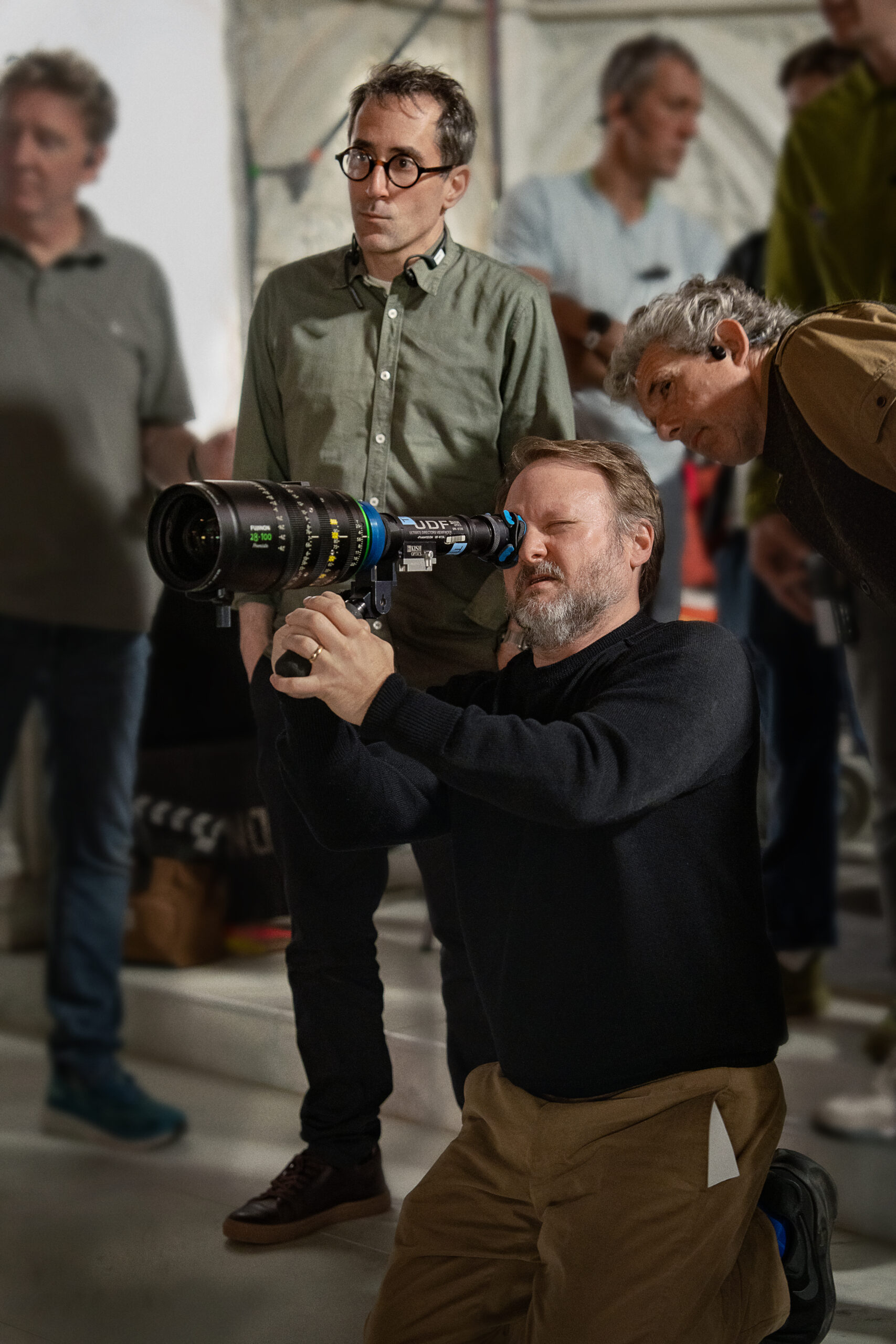
It was something I absolutely started thinking about in the writing phase. It was the first conversation I had with Steve, which was, first of all, the tonal mood of the whole movie being a little bit more gothic. This is definitely more of a lighting movie than the previous two were. The big conversation I had with Steve, I grew up as a kid in Colorado where the clouds move very fast. It doesn’t happen so much in Southern California, maybe in Chicago it does more often, but you’ll be in a room, it’ll be bright and warm and sunlit, and then the sun will go behind a cloud and like that [snaps fingers] it’ll suddenly be dark. You can barely see each other and it’s dim and cool. The emotional language of the room changes. It’s something that happens a lot in real life and you don’t see in movies very often. I wanted to get very theatrical with those light changes, particularly in the church.
So Steve did a ton of work and that interior of the church was a set that Rick Heinrichs, our production designer, built. Steve prerigged it with all these lights and worked out the lighting control system where on set, just on his laptop, we could play the light changes like we were playing music. We could shape them to the scene as it was happening and repeat them take after take. My favorite thing is when I talk to a friend and they’re like ‘oh my god, that must have been magical on set when you guys got lucky and the sun just happened to have come out when he was giving that speech.’ I always say, ‘Yeah, yeah, it was really lucky.’ [Laughs] That’s absolutely how I want you to feel. That’s great.
Just the right place, the right time.
Exactly. Just a lucky guy.
Speaking of right place, right time, you’re closing out the unofficial Josh O’Connor fall and he is such a versatile actor. I spoke with Kelly Reichardt about him in “The Mastermind” and she had said he has this timeless mug that can fit into anything then immerse himself in it. Was he the person that you had in mind when you were writing this?
No, I wasn’t aware of him actually. It was Daniel during the casting process who brought him to my attention. Daniel knew him through Luca [Guadagnino] and “Challengers” wasn’t out yet so they screened “Challengers” for me. It was my favorite movie of that year and I just thought this guy burns his way off the screen, he’d be amazing. Then I saw “La Chimera” and it’s the versatility that you’re talking about. To see him working at the completely opposite end of the spectrum and be equally as captivating. Then I started digging into some of his other work and then I met him and I was just like I want to be on a set with this guy.
I appreciate that you give him this comic range as well. The story I tell other critics is he at Sundance came into the press office and just sat behind all of us and started talking about Waffle House. I think he was messing with us and so I was curious if he added to the humor? Just his expressions, the way his face falls.
I mean, I knew he was funny, but to give him full rein with this part to dive into that humorous aspect of it, he played it so well. Also to give him a part where he can be a leading man. Glenn Close kept saying that he reminded her of Jimmy Stewart in this role. I think that’s a great analogy. He can do “Challengers,” he can do “La Chimera,” he can do “The Mastermind,” he can do “History of Sound,” and then he can step onto this set and be a leading man in that way. He can grab the audience in a movie where people are showing up expecting Daniel Craig to step forward. The fact that he is the one grabbing people and bringing us through that important first act and we never blink away from the screen, it’s extraordinary to me.
While you’re happy to see Daniel Craig show up, you’re never impatient for that moment.
Was there ever a moment where you were nervous about trusting everyone with that? Because more than any of the other films, this is the latest he is properly brought in.
I guess I was theoretically nervous because I knew what you were saying was true and expectations can be a tricky thing. I was never actually nervous because I knew once we got Josh, I was like, ‘I think this is going to work.’ But also, as a murder mystery fan, this is the more traditional structure of an Agatha Christie book. This is typically how it works. The first act, you’re meeting all the suspects, you’re getting a good sense of who is going to get killed. End of first act, they get killed, the detective shows up, the investigation starts up. I knew it could work because it had worked my whole life in murder mystery novels. Then it’s just a matter of doing the work and making sure that first act is as tight and compelling as it can possibly be. If it is, then you got to have faith in the storytelling. You got to take a bet on yourself and just say you can’t have the studio note of ‘can we get the big dog in there sooner?’
It never feels like you’ve taken a studio note.
I kind of haven’t. On the one hand I have been very, very lucky that I’ve worked with people at studios who have given me just the freedom to do what I wanted to do. On the other hand, I never come into a relationship, whether it’s with a producer or a studio head or whatever, it’s a bit like Father Jud of this [spreads arms wide in an embrace] and not this [raises fists as if ready to fight]. I think how you enter that relationship and the tone you set from the very start very much will inform the level of trust between you. That’s if you’re working with a good studio head which I have been very lucky to, whether it’s Kathy Kennedy and Bob Iger and Alan Horn and Alan Bergman on Star Wars or whether it’s Ted Sarandos and Bela Bajaria and Dan Lin at Netflix. If you come in and if you’re instantly like ‘it’s me against you,’ then I can see that creating that dynamic, a self-fulfilling prophecy. But if you come in and say, we’re all making the movie together and I have in my head what I think it should be and if you have notes, great, let me hear them, and if I disagree with them, I’ll say so and tell you why. Then it just becomes a process and ultimately one based on trust I think.
It’s a collaboration.
Yeah, it has to be.
I will say then you also aren’t afraid of having a little bit of fun joking around with your collaborators because you make two jokes: one about Star Wars and about Netflix.
[Laughs] it’s true.
When did you find those moments of ‘okay, this will fit and I would love to do this?’
It was while I was writing the script. The Star Wars one I couldn’t resist, because it is a fun joke about Star Wars, but also the joke actually speaks to a real truth of everyone thinks they’re the rebels [laughs]. Then I thought the Netflix joke would just be funny. If it felt too inside baseball, that’d be one thing, but I think because these movies do exist in the present moment culturally, or they’re meant to, I felt like ‘ah, these people would say this.’ It’s okay to try.
I listened to the talk you gave at the BFI where you talked about the murder mystery as a way to reflect on the present moment. This movie doesn’t shy away from faith being used as a weapon, from faith being used as a tool of hate and division. It feels as though on one shoulder there is Josh Brolin, the devil, and on the other shoulder there is Josh O’Connor, the angel, and that battle between their characters.
Absolutely. Also, they both represent aspects of faith as I was brought up in it. I didn’t grow up Catholic, I grew up Protestant evangelical. We were a right-wing, Christian household, and I was very much that as well, up through when I was a teenager. That’s what I was raised in and that’s who I was. I’m the opposite of all of that now, but it’s something that I have empathy for because I know where it comes from because I was once that. I also feel like I do have both of those experiences with faith. With the Father Jud side, which are most of the red ink parts of the New Testament and is most of what Christ actually said, of compassion and grace and all the good stuff. And then there is the element that can weaponize faith and use it the way Wicks does to build walls around us. To say we’re in a fortress and in a battle with the people outside it, the other, and cruelty towards them is justified because they’re trying to destroy us, or they’re trying to take away something, whether it’s power or something, that should be ours. So I’ve experienced both aspects of that in my life and in the church and faith. I wanted both of those things to be represented and not shy away from vividly representing those things. It’s a movie so both of those things, which are kind of clouds of things I’ve felt, are distilled down into two characters, neither of whom I’ve ever met anyone quite like. In the case of Wicks, thank god. But it all speaks to my own experience.
At the film’s premiere at TIFF, one of the last things you said before the lights went down was ‘let’s go to church.’ Has cinema become your church?
It always has been. When I was a teenager, cinema was still my church. I had a very personal relationship with Christ when I was a Christian. That was something that was very internal but it wasn’t fed by going to church and hearing sermons and by hearing the choir. I was always bored to death in church honestly. My faith was something that was very passionate and alive inside me. It was almost like the lens that I saw the whole world through and framed the world around me through. It was a living faith. But even at the time, the things that were inspiring me were movies, especially as I got into my twenties and fell away from faith and no longer believed. When that goes away, you have to find something to replace it. You have to find a different framing device for the world. Movies were part of that. They weren’t the whole thing for me, but movies were definitely part of that. Today, if I think about places I go into that have a ritual to them, where you enter in and sit down and give your attention and are bestowed an experience that hopefully moves and lifts you to a higher plane and you leave that space a little bit changed, that describes church for some people and it describes the movies for me.
“Wake Up Dead Man: A Knives Out Mystery” is now playing in limited theaters and will be available to stream on Netflix starting Friday, December 12.
from Roger Ebert https://ift.tt/riu7AVj
.png)


